By Michael Beaumont
Photos by Megan Armstrong
Goodnight From Thebes: An Adaptation of Antigone by Sophocles
Directed by Finn Wesolowski & Sydney Edwards
Hopefully you made it out to see our own theatre teacher’s very first adaptation performed at The Arts Academy at Benjamin Rush. Sally Wojcik comes from Springfield, MA, and studied Theatre, English, and Secondary Education at Albright College where she graduated summa cum laude (latin for “with very great honor”) with Departmental Distinction. After college, Ms. Wojcik accepted a position at Arden Theatre Company in the Arden Professional Apprentice Program (one of the country’s most rigorous theatre programs) and remained on staff in the Education & Marketing Department for five years! The play Ms. Wojcik adapted and modernized was none other than Antigone by the Greek tragedian Sophocles. Antigone tells the story of the Labdakos Family tree.
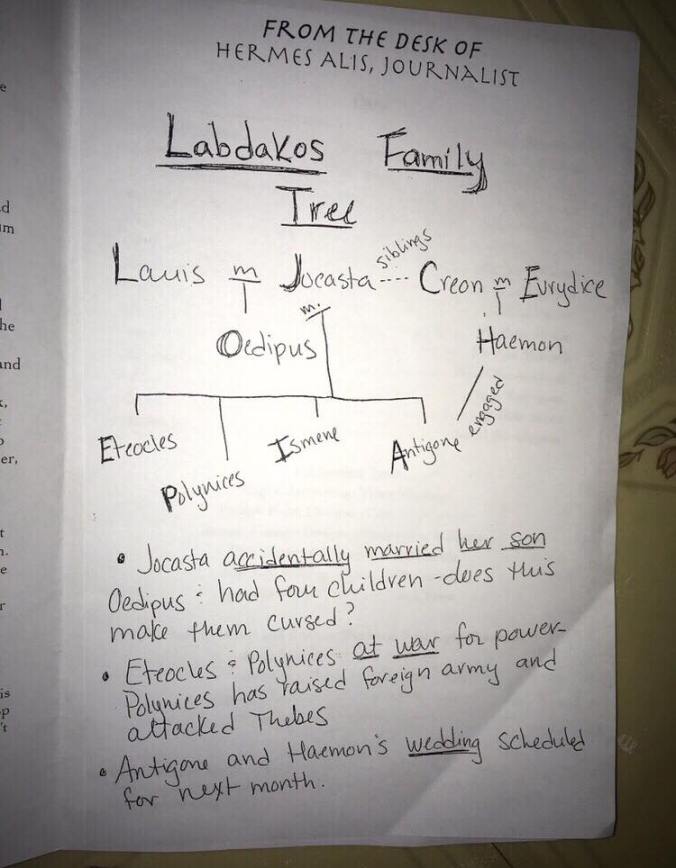
The tree can be very confusing at times so please refer to the picture of the lineage if you are confused. In short the play begins with Jocasta and Creon, two siblings whose offspring intersect platonic relationships with unintended incestuous ones. Creon, the up and coming ruler of Thebes is wed to the silent king Eurydice and has a rebellious and headstrong son named Haemon. On the other side of the tree regarding Jocasta’s lineage, she was wed to the late Laius before he was killed by his own son Oedipus over her love (for more information please refer to the story of Oedipus). Oedipus has four children with Jocasta before either of them know his true heritage, Eteocles, Polynices, Ismene, or Antigone, Haemon’s beloved fiance.
The plot of the play centers around the murder of Polynices in the land of Thebes and is very character-driven. In order to fully capture this kind of tragedy, I knew the casting had to be good for this modernized version to stand next to the original. Erinda Sheno stepped in as Creon, the ignorant ruler and main character. Her emotional range and strong diction really captured my attention and made me feel as if I was watching royalty. Despite being known as a friendly academic in school, these last two nights left me baffled as she transformed into a selfish ruler bestowing harsh and biased judgements down on her subjects. It even reached the point where Sheno physically threatened one of her underlings on stage to assert dominance. However, what really drove her performance home for me was her emotional breaking point in a scene when Creon came to learn from the prophet Teiresias about her wrongdoings and the punishment her and her family would face if she continued down that road, she swiftly rushed to her son’s side ashamed of the actions she had committed. This character development was phenomenal and I don’t think the theatre department could’ve chosen a better person to portray this complex character.
The deuteragonist was cast by none other than the girl of many faces, Ambria Hartie. Known for her headstrongness and determination in school, it was no surprise to see Hartie tackle the role of the criminal Antigone. What did shock me was her captivating show of Antigone’s mental breakdown when looking death straight in the eye. I became incredibly watery-eyed as Hartie’s tear-jerking meltdown and insanely genuine diction forced me to feel an incredible amount of sympathy for her character. Her emphasis on her words and passion in her voice was definitely a powerful weapon in this performance.
One of the main differences between this play and the original source material was Ms. Wojcik’s executive decision to “modernize” the story using today’s technology and reverse gender roles. Honestly, the decision to use Twitter and live streaming to show the live reactions of the city’s population was genius; I couldn’t believe my eyes when the projector screen showed the live performance I was witnessing myself. Since modernizing this ancient play was a risky move, Matthew Horan took on a potentially catastrophic role as Hermes, the reporter of Thebes. By delivering live updates and commentary on the case regarding the royal family, Horan really entertained the crowd as the token relief character. Accompanying him was Iris, played by Sara Rodriguez, whose role was to read background information to Horan to give him a basis for his commentary. At first, I had no idea how this idea would work out when I first heard it, but after seeing this performance I realized it couldn’t go on without it.
I think my favorite part of the whole piece was the bravery to change the genders of the main cast. As well-known in ancient theatre, men have played nearly every role, even the female ones. This was mirrored in the original play with women having little to no power. I knew going in that this wouldn’t have sat right with a modern audience, especially with all of the LGBTQIA movements in the world these days. Originally, Creon seized the throne as a result of being the eldest son. However, in this adaptation Creon (changed to a woman) simply seized control because she believed she was the eldest sibling and as a result, Eurydice’s role completely changed. Initially, Eurydice was the silent wife of a powerful man who had no lines at all and her only role was to support her husband. The gender swapping of the characters put a man in her spot who had no lines and only served to emotionally support his wife’s kingship. I thought this was a politically woke move as it hit me how oppressive ancient theatre was in terms of casting.
Overall, the modernized play brought life into an already well-known play. The theatre department did a fantastic job advertising this performance, setting it up, and putting on a great show. Despite being only an hour long, this performance enticed many and took them on a roller coaster ride of emotions through ancient Greece and into a dilemma that even the smartest man would struggle to resolve. Thank you to everyone who put their blood, sweat, and tears into this show, because it was definitely one I’ll never forget!


 The Palette
You must be logged in to post a comment.