By Aidan Schuster
Every weekday, many high school students wake up groggy, unprepared, and unmotivated to learn and work throughout the day. Some people attribute the lack of motivation to late nights with technology and social media, or simply “teen laziness.” While social media certainly does not help healthy sleep schedules, 30 years of research have shown that, biologically, teenage sleep patterns are different from the behaviors seen in adults and younger children. In teens, the sleep hormone melatonin doesn’t release until 11 PM — two hours later than it does for everyone else. Therefore, for teens, the core hours of REM sleep — the type of sleep most associated with learning, memory consolidation, and emotional processing — are between 5 and 8 AM. In light of these findings, the Centers for Disease Control and Prevention (CDC), the American Academy of Sleep Medicine (AASM), and other prominent health organizations recommend that high schools start no earlier than 8:30 AM.
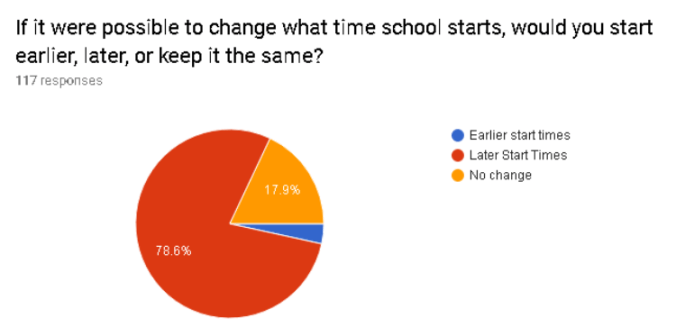
Intrigued by the prospect of later high school start times, Rush Arts Senior Aidan Schuster created a website and conducted a survey for his senior project to gauge how the Rush Arts community feels about high school start times. He received 117 responses: 54 freshmen, 20 sophomores, 14 juniors, 20 seniors, 7 teachers, and 2 parents. Of these, 92 participants (78.6%) supported later start times, 21 (17.9%) wanted no change to start times, and 4 (3.4%) advocated for earlier start times. It should be noted, however, that one of these votes for earlier start times was contradicted in the comments, indicating “We should come in a bit later… to help students,” citing those who “wake up at extreme hours” to take multiple buses.
Both students and teachers contend that teenagers would be more motivated to learn if they had additional sleep. Students cited how early they wake up for school, compounded by how late they get home from jobs, extracurricular activities, and after-school practices and rehearsals. One sophomore said,
I wake up at 4 in the morning because I need to commute so far and because public transportation is so unreliable. I don’t eat breakfast and I don’t have time to properly wake up. I get home around 4:30 on a good day and immediately pass out. Other times I have to stay after school until ungodly hours and just go with a couple of hours of sleep (hopefully). Later times would at least let me have a better sleep schedule and be able to do more at home.
Other students also described their “exhausting and stressful” morning routines: “dreading” their alarms, “struggling” to wake up for public transportation and staying awake for their stop, and scarfing down or eating no breakfast at all.
One parent noted their son’s behavior during Senior year:
While I have seen a few instances of late nights and difficult homework during my son’s Freshman through Junior years, Senior year has been significantly more intense, particularly with AP classes. As a result, he is frequently up until 1 or 2 am finishing homework and preparing for bed, then is nearly impossible to get out of bed in the morning to catch the bus at 6:45 am. Even on nights when homework is light, he is not ready to head upstairs until well after 11 pm, due to teen biology and this established late night pattern. Due to this prolonged lack of sleep over the last 6 months, he is far more frustrated, irritable, indecisive, snappish, and moody than I have ever witnessed before. I do not like to see my son this way and feel this is a very unhealthy routine. I know there would be issues to resolve in any plan to start school later, but I feel it would give students a much better chance to get the rest they need to be healthier physically, mentally, and emotionally; more energized and successful in school, sports, activities, and jobs; and safer while traveling to and from these places.
Among the teachers calling for later start times was Athletic Director Todd Corabi:
Circadian Rhythm in teens and hormone levels between ages 13-19 dictate that [teens] are not capable of falling asleep until roughly 11:00 pm. If you factor in jobs, distractions from social media/phone calls, and blue light effects on sleep patterns from looking at computer and phone screens all day, along with travel times to school, it is not possible for teens to get the 7-8 hours of sleep needed to be successful in school OR wake up fully by the normal school start times between 7:30-7:50 AM.
Graphic Design and Media teacher Louis Mazza “notices a huge increase in energy and an improvement in participation and engagement on occasions when school starts later,” such as two-hour weather delays and reversed half-days due to testing.
Mathematics teacher Jonathan Goulet observes:
Students in the earlier periods seem to perform worse in my classes and have a more difficult time with the material. I also think this has an effect on students in the last couple of class periods as well. I believe that starting school later, perhaps by 30-60 minutes, would make a big difference in the quality of sleep that students get, and would have a positive impact on how much energy students (and teachers) would have at the beginning of the school day.
Another parent adds:
Based on the prevailing information provided by institutions like the CDC, and seeing the increase in school-related violence on the rise here in the United States, and the lack of those issues in other countries that have adopted later start times for school… there should be no reason [not] to adopt later start times, as the benefits outweigh the negatives brought out by some individuals and groups.
Pennsylvania State Code requires 990 hours of instruction per year for middle school and high school students. If Rush decides to change its start time, how will its end time be affected? Nearly all responses calling for no change cited interference with their jobs, extracurricular activities, sports, parental schedules, and transportation as potential reasons why change should not be implemented. Several individuals who support later start times also raised similar concerns, including Mathematics teacher Jeff Bevilacqua:
Since the school day still needs to be 7 hours long, and if you add 2+ hours for a practice/meeting, then students wouldn’t be released until later in the evening (depending on the start time… for example, a 10 a.m. start time would mean leaving practice at/after 7 PM). Or would some sports/clubs start practicing/meeting before school, which would then counter the reason for shifting the school day in the first place? Unfortunately, I think we will continue to do what we do because it is what we have always done. It will take a lot of energy and commitment to make the shift, and I wonder if/when it will happen. But in the end, I think it would be worth it: if research shows that it would be good for students and that the effects would be significant, then we should at least try it.
One potential schedule, Corabi suggests, is:
If we started school at 8:15 and went until 3:19, the students would be able to get at least 30 minutes more sleep per night. Furthermore, if students began school the week of August 13th, when athletics start, and went from 8:00 AM-4:00 PM, we could get out of school the Friday before Memorial day each year without losing any time AND have at least 2 Fridays per [month] off from school all together ([if not] all Fridays).
Across the country, the issue of school start times remains controversial. Considering such a change at Rush, whether it is Corabi’s proposal or another option, is also likely to face challenges, but three decades of research and this recent survey feedback from the Rush Arts community suggest later school start times might be worth a try.
 The Palette
You must be logged in to post a comment.